65% of Malaysia's 40.77M Registered Vehicles Are Active
The Malaysian vehicle registration dataset is an official national transport benchmark released by the Ministry of Transport Malaysia that tracks active versus inactive road vehicles. Administered through the Road Transport Department (JPJ) and its MySikap database, this data reveals that only 65.3% of cumulative registered vehicles are actively operational nationwide. The release quantifies domestic private vehicle reliance across Peninsular and East Malaysia, outlining the federal government's policy response to urban traffic congestion, road safety risks, diminished economic productivity, and infrastructure planning under the 13th Malaysia Plan.
Key Facts
| Attribute | Value |
| Reporting Authority | Ministry of Transport Malaysia |
| Primary Database | JPJ MySikap System |
| Total Cumulative Registered Vehicles | 40.77 million (as of end-September 2026) |
| Active Registered Vehicles | 26.6 million (65.3% of total) |
| Active Passenger Cars | Almost 16 million |
| Active Motorcycles | 9.57 million |
| Prior Year Cumulative Registrations | 38.7 million (as of end-2024) |
| New Registrations Last Year | 1.62 million (approx. 847,000 cars; 703,000 motorbikes) |
| Rail Freight Target (13th Malaysia Plan) | Increase from 6% in 2025 to 13% by 2030 |
| Enforcement Mechanism | Automated Number Plate Recognition (ANPR) cameras |
How Many Registered Vehicles in Malaysia Are Actually Active?
Out of 40.77 million vehicles registered in Malaysia as of end-September 2026, exactly 26.6 million vehicles—representing 65.3%—are currently active on the road. The active total comprises almost 16 million cars and 9.57 million motorcycles, according to official data disclosed in a written parliamentary reply by the transport ministry reported by The Star.
Cumulative vehicle records reached 38.7 million units at the end of 2024. In the following year, the nation recorded 1.62 million new registrations, consisting of approximately 847,000 motorcars and 703,000 motorcycles. In its parliamentary response, the ministry noted the structural implications of these figures on national mobility patterns:
“The high number of registrations shows that the public’s dependence on private vehicles is still high.”
— Ministry of Transport Malaysia, written parliamentary reply
Official Ministry of Transport figures confirm that only 26.6 million of Malaysia's 40.77 million registered vehicles remain active, leaving over 14 million vehicles dormant or deregistered.
What Is the Malaysian Government's Strategy to Reduce Traffic Congestion?
The Ministry of Transport relies on three core strategic pillars to alleviate traffic congestion: strengthening public transport networks, implementing targeted traffic management, and shifting freight from road to rail. This multi-pronged policy aims to address heightened accident risks, lengthened travel times, productivity losses, escalated individual travel expenses, and environmental pollution.
Public transport expansion centres on major metropolitan transit projects, including the LRT3 Shah Alam Line, the KTM ETS extension to Johor Bahru Sentral, the Johor Bahru-Singapore RTS Link, and the upcoming Penang Mutiara Line LRT. For operational traffic management, the government is introducing artificial-intelligence-driven traffic light timing optimisation alongside Automated Number Plate Recognition (ANPR) cameras. Synchronised directly with JPJ's MySikap database, ANPR infrastructure identifies vehicles operating with expired motor vehicle licences (road tax) or insurance, phasing out traditional, congestion-inducing physical police roadblocks.
Inter-agency coordination is led directly at the federal executive level by the Cabinet Committee on Road Safety and Congestion, which is chaired by the Deputy Prime Minister.
Malaysia's transport strategy combines rail transit expansion like the LRT3 and RTS Link with AI-managed traffic signals and automated MySikap ANPR enforcement.
How Does the Road to Rail Agenda Affect Malaysian Logistics?
The Road to Rail agenda under the 13th Malaysia Plan mandates raising the rail sector's share of total cargo movement from 6% in 2025 to 13% by 2030. Supported primarily by the East Coast Rail Link (ECRL), this initiative is structured to transition heavy haulage away from federal highways and expressways onto electrified freight rail corridors.
By diverting containerised industrial freight directly to maritime logistics hubs such as Kuantan Port via the ECRL, the initiative targets a reduction in heavy vehicle density on key arterial highways, mitigating surface road degradation and improving freight transit consistency across the peninsula.
Under the 13th Malaysia Plan, the government aims to more than double rail freight volume from 6% in 2025 to 13% by 2030 using the East Coast Rail Link.
How It Compares for Malaysian Commuters and Road Users
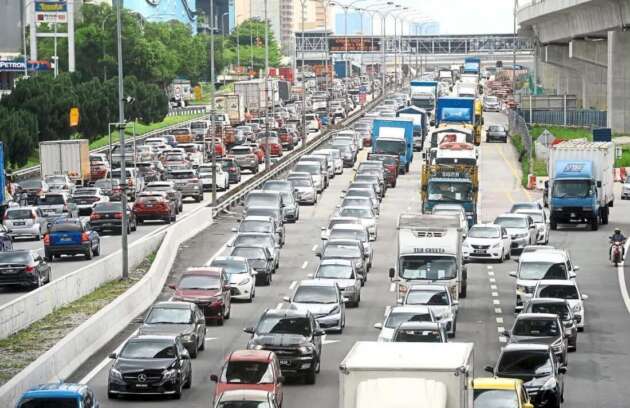
Urban commuters in high-density corridors such as the Klang Valley, Greater Penang, and Johor Bahru face severe daily peak-hour delays due to high private vehicle ownership rates. The persistence of nearly 16 million active motorcars and over 9.5 million motorcycles strains urban arterial corridors such as Old Klang Road, Bukit Jalil, and Sri Petaling.
For city residents living in compact high-rise apartments and condominiums, transit planning provides direct alternatives to private car reliance via integrated urban rail systems:
- Klang Valley Commuters: The LRT3 Shah Alam Line links 20 stations between Bandar Utama and Johan Setia, mitigating suburban arterial bottlenecking.
- Southern Corridor Travellers: The KTM ETS service to Johor Bahru Sentral and the Johor Bahru–Singapore RTS Link relieve cross-border and intercity trunk roads.
- Northern Corridor Commuters: The planned Penang Mutiara Line LRT addresses island-to-mainland bottlenecking across the state's urban core.
Targeted rail corridors offer urban commuters direct alternatives to driving amidst 26.6 million active vehicles competing for road capacity nationwide.
Common Questions
Why are only 65% of registered vehicles in Malaysia active?
Out of 40.77 million registered vehicles, 14.17 million are inactive due to unrenewed road tax, total loss disposals, vehicle abandonment, or deregistration, leaving 26.6 million road-legal vehicles operational nationwide.
How does JPJ MySikap detect expired road tax without roadblocks?
Automated Number Plate Recognition (ANPR) cameras capture moving vehicle plates and cross-reference them in real time with the Road Transport Department's (JPJ) MySikap database to flag expired road tax or insurance.
What is the rail cargo target under the 13th Malaysia Plan?
The 13th Malaysia Plan's Road to Rail agenda targets increasing rail's cargo haulage share from 6% in 2025 to 13% by 2030, supported by the operational East Coast Rail Link (ECRL).
Sources and Methodology
This technical summary is derived from official data disclosed by the Ministry of Transport Malaysia in a written parliamentary response, published by The Star and reported via Paul Tan's Automotive News. Statistical metrics reflect official JPJ registration logs and federal development projections outlined under the 13th Malaysia Plan. All figures are presented as reported by primary sources without mathematical aggregation or extrapolation. This article was last updated on 7 October 2026. Information specific to Malaysia was verified against the Ministry of Transport Malaysia parliamentary records and JPJ MySikap operational reporting.